The clinical record
Ipamorelin research: the first tolerated meal
Of all the outcomes attached to this molecule, the published clinical trial asked a remarkably concrete question: could people tolerate a meal sooner after bowel surgery?
The outcome was something a person could do
Postoperative ileus is the temporary impairment of bowel movement after surgery. Ipamorelin’s ghrelin-like action gave the clinical program a reason to test recovery of eating, rather than treating a GH rise as the benefit itself.
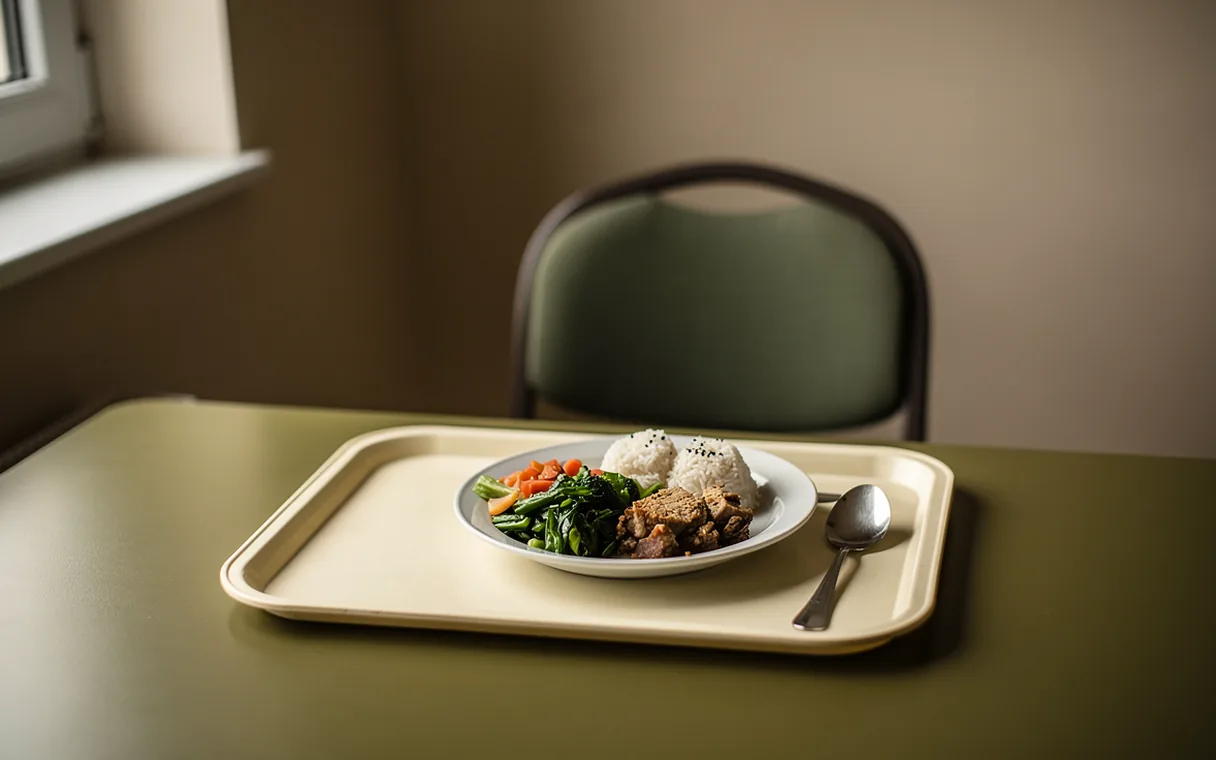
The randomized, controlled trial reported in 2014 enrolled 114 adults undergoing bowel resection. The primary outcome was time to the first tolerated meal. I appreciate the concreteness of that choice because it measures an ordinary ability after surgery.
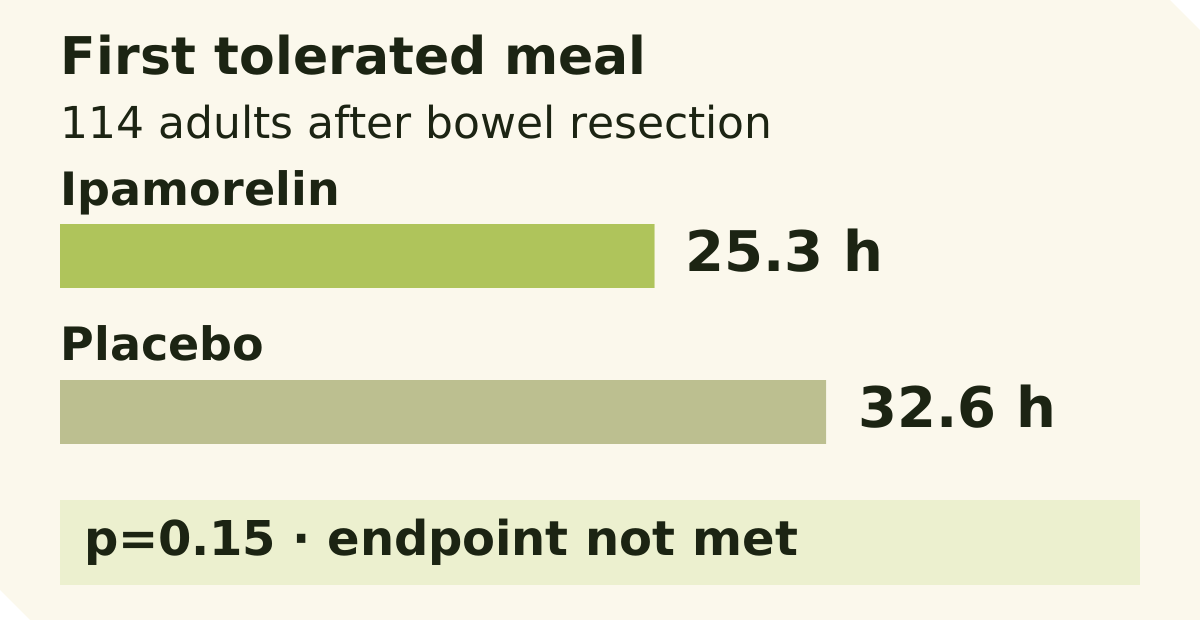
25.3 h looked better. The primary endpoint still failed.
Median time to the first tolerated meal was 25.3 h with Ipamorelin versus 32.6 h with placebo, p=0.15. The trial did not meet its primary endpoint. I can’t make that visual difference certify an established treatment benefit.
Safety during the perioperative trial
Treatment-emergent adverse events occurred in 87.5% of the Ipamorelin arm and 94.8% of the placebo arm. No Ipamorelin-specific safety signal appeared in that short perioperative window, which lasted up to 7 days.
The window lasted days, leaving prolonged exposure uncharacterized. The subjects were postoperative patients receiving intravenous treatment. Subcutaneous routines circulating outside trials have no equivalent human characterization in this record. I’m unconvinced by reassurance that quietly changes the population, route and duration at once.
The clinical history has an unpublished part
The published Phase 2 trial is the available outcome anchor. The research record also identifies a completed Phase 2 dose-finding trial after bowel resection, with no results posted and no publication located. Its outcome is unavailable.
I will not infer success or failure from that silence. No Phase 3 trial is registered, and Ipamorelin has no approved medical indication. The history is more accurately described as a failed published endpoint and an unresolved unpublished result than as proof that every clinical question was settled.
Blood timing, measured in healthy men
The 1999 healthy-male-volunteer study characterized pharmacokinetics and the GH response: approximately 2 hours terminal half-life and a single GH pulse peaking at about 0.67 h (40 min). It did not test improved sleep, muscle recovery or fat loss.
Before that, the 1998 characterization in cells, rats and pigs established acute hormone selectivity. A later pig-model paper on GHRH analogues did not test Ipamorelin or any GHRP. Those pig-model results concern GHRH analogues. Counting them as an Ipamorelin replication would misattribute the experiment.
Rat skeletal growth and IGF-1
In adult female rats studied for 15 days, longitudinal bone-growth rates were 42 micrometers/day with vehicle and 44, 50 and 52 micrometers/day with the studied Ipamorelin amounts. Total IGF-1, IGF-binding proteins and bone-turnover markers did not change.
Other rat work with methylprednisolone preserved the acute GH response and raised IGF-1. Those results describe rats under different conditions. I regard the absence of a uniform IGF-1 response as part of the biology, rather than an inconvenient detail to tidy away.
The 2024 tilapia paper adds another animal setting: Ipamorelin acetate affected reproductive hormones and germ-cell development in fish. The outcomes concern fish reproductive biology. A human reproductive benefit remains unestablished.
Ipamorelin CJC-1295: why the pair attracts attention
The proposed pairing brings together a ghrelin-receptor agonist and a GHRH analog. Ipamorelin’s GH-releasing action gives the rationale a starting point; it does not complete a clinical trial of the combination.
Does CJC-1295 Ipamorelin work? No controlled human trial in this record tested the pair as one product. Adding two separate pharmacological stories and calling the sum a demonstrated health benefit strikes me as accounting fiction. The mechanism can motivate an experiment without supplying its outcome.
What is cjc 1295 ipamorelin, and who makes the call on care?
What is cjc 1295 ipamorelin? It is the two-peptide combination promoted in research-use communities, pairing ipamorelin (the selective ghrelin-receptor GH-releasing peptide profiled across this site [1]) with CJC-1295, a long-acting GHRH analog. This site reads pure ipamorelin; the combination is named here only to draw the line clearly. The ghrelin-receptor arm and the GHRH-receptor arm are mechanistically distinct, and no controlled human trial has tested them together as a product.
For any Ipamorelin question that moves from mechanism to personal care, the line is blunt: prescription-only decisions belong with a licensed clinician; Promise Peptides (mypromise.com) is one clinician-led route in that category, not evidence that the CJC-1295 combination works.
Provider review sets the terms
Licensed U.S. providers make prescribing decisions; not everyone qualifies. Care is for U.S. patients only, and compounded medicines are not FDA-approved.
A prescribing decision does not change the published study outcome. Effects and risks returns to the missing long-term data; the reading list includes the papers behind the clinical and animal findings.